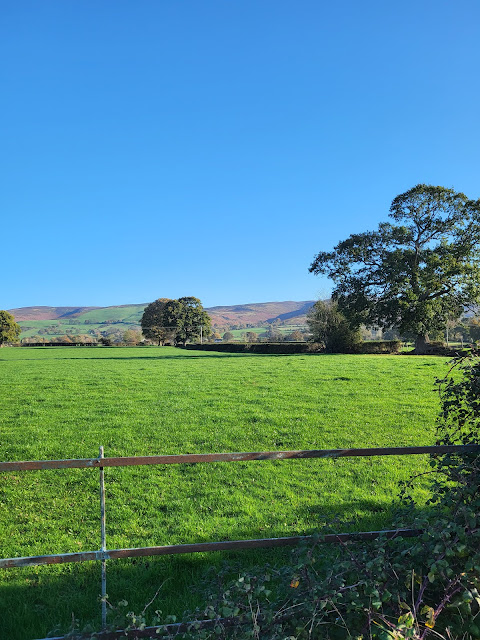
welsh hills again
gardens and growing things, cooking and eating things, family and friends, books and wine
Sunday, 20 May 2012
A short break
I am just going to take a short break from blogging, nor for serious purposes, not to write a novel or go on a mature gap year to South East Asia, not even to devote my undivided attention to my family and friends. I just feel like lying back into my life like flinging yourself into long grass and looking up at the sky. I shall just have a few days off to float and be, without a word written or a photo taken!
Tuesday, 15 May 2012
Scented leaf geraniums
I love scented leaf geraniums. I love the flowers, delicate and perfect, and the scent of a leaf rubbed on your fingers. I have Attar of Roses, Orange Fizz, and Lady Plymouth, Clorinda, Sweet Mimosa, Atomic Snowflake, Citronella and Deerwood Lavender Lad. The names themselves are a pleasure.
This is Attar of Roses, grown for its strong rose scent which is used in the perfume industry.
This is Orange Fizz. Rub a leaf between your fingers and the scent is the smell released by peeling an orange. The flower, like all scented leaf pelargonium flowers, is simple: this one a pale pink flared with deep purple.
This is Citronella. The flower is similar. You might struggle to see the difference, although the purple flare is more delicate, but the scent of the leaves here is strongly lemon, more lemon than a lemon!
And this is Lady Plymouth. The leaf is a sage green with a white edge and the flower a simple, slightly lavender pink. The leaves are scented a peppery citrus.
So you can see that if you want a variety of colour and flower to rival begonias and gladioli, scented leaf pelargoniums are not for you. The differences are subtle, the flowers delicate and similar in size, shape and colour. The differences need a close eye. But the range and variety is in the scent of the leaves. The scent of a cedar leaved plant like Clorinda is vivid and particular, you could bottle it and put it in a wardrobe to keep moths away. The scent of Deerwood Lavender is as delicate and pure as lavender itself. The flowers are deep mauve. Sweet Mimosa is as sweet and light as its name.
Scented leaf pelargoniums are incredibly easy to keep although they seem to have a mystique about them. The essential message is to keep them lean. They grow best in pots in my experience. Plant them into a mix of potting compost and grit, about one third grit to two thirds compost. Because they can cope with drying out, they grow well in terracotta pots which dry out more quickly than plastic. Plastic pots are often more efficient with other plants because they dry out more slowly. Terracotta pots however are far more beautiful and this is a case where terracotta works on all fronts! You can include a slow release fertiliser but I have found that they are fine without as long as they are watered two or three times a week in the spring and summer.
Scented leaf geraniums are half hardy and should be kept in a cool greenhouse or porch until you are absolutely sure that the risk of frost has passed. In summer they can be left outside. In autumn, as the weather cools, keep an eye out for frosts and bring them inside if frost is forecast. Sound simple eh?
I must admit that for years I messed up with both these and flowering pelargoniums. I would buy them. I would look after them over the summer. I would put them in an unheated greenhouse and feel reassured. Winter bore on. It got colder and colder and life outside of the house disappeared from view. Why go outside when it is so supremely miserable? At some point in the year the temperature would drop from round about freezing to well below. My plants couldn't cope. I would go out a week or so afterwards and find them blasted. I would always persuade myself that they might revive. This was always rubbish.
These plants don't need much but they do need not to freeze, a simple lesson but one which took me years to learn. If you don't heat your greenhouse, bring them inside. If you do, make sure your minimal heating will kick in. If you don't have a greenhouse at all you might be better at keeping them going as the only thing to do is bring them inside. A cool porch, an unheated bedroom, a chilly corridor, all will do if they don't make your cat's water bowl ice over.
I might just be indulging myself here but I will do another post on cuttings and how to propagate them.
This is Attar of Roses, grown for its strong rose scent which is used in the perfume industry.
This is Orange Fizz. Rub a leaf between your fingers and the scent is the smell released by peeling an orange. The flower, like all scented leaf pelargonium flowers, is simple: this one a pale pink flared with deep purple.
This is Citronella. The flower is similar. You might struggle to see the difference, although the purple flare is more delicate, but the scent of the leaves here is strongly lemon, more lemon than a lemon!
And this is Lady Plymouth. The leaf is a sage green with a white edge and the flower a simple, slightly lavender pink. The leaves are scented a peppery citrus.
So you can see that if you want a variety of colour and flower to rival begonias and gladioli, scented leaf pelargoniums are not for you. The differences are subtle, the flowers delicate and similar in size, shape and colour. The differences need a close eye. But the range and variety is in the scent of the leaves. The scent of a cedar leaved plant like Clorinda is vivid and particular, you could bottle it and put it in a wardrobe to keep moths away. The scent of Deerwood Lavender is as delicate and pure as lavender itself. The flowers are deep mauve. Sweet Mimosa is as sweet and light as its name.
Scented leaf pelargoniums are incredibly easy to keep although they seem to have a mystique about them. The essential message is to keep them lean. They grow best in pots in my experience. Plant them into a mix of potting compost and grit, about one third grit to two thirds compost. Because they can cope with drying out, they grow well in terracotta pots which dry out more quickly than plastic. Plastic pots are often more efficient with other plants because they dry out more slowly. Terracotta pots however are far more beautiful and this is a case where terracotta works on all fronts! You can include a slow release fertiliser but I have found that they are fine without as long as they are watered two or three times a week in the spring and summer.
Scented leaf geraniums are half hardy and should be kept in a cool greenhouse or porch until you are absolutely sure that the risk of frost has passed. In summer they can be left outside. In autumn, as the weather cools, keep an eye out for frosts and bring them inside if frost is forecast. Sound simple eh?
I must admit that for years I messed up with both these and flowering pelargoniums. I would buy them. I would look after them over the summer. I would put them in an unheated greenhouse and feel reassured. Winter bore on. It got colder and colder and life outside of the house disappeared from view. Why go outside when it is so supremely miserable? At some point in the year the temperature would drop from round about freezing to well below. My plants couldn't cope. I would go out a week or so afterwards and find them blasted. I would always persuade myself that they might revive. This was always rubbish.
These plants don't need much but they do need not to freeze, a simple lesson but one which took me years to learn. If you don't heat your greenhouse, bring them inside. If you do, make sure your minimal heating will kick in. If you don't have a greenhouse at all you might be better at keeping them going as the only thing to do is bring them inside. A cool porch, an unheated bedroom, a chilly corridor, all will do if they don't make your cat's water bowl ice over.
I might just be indulging myself here but I will do another post on cuttings and how to propagate them.
Wednesday, 9 May 2012
Things beginning with s
Swallows: they are back. I have been watching for weeks, looking out of the window, glancing up as I walk across the gravel, turning to look over my shoulder as I go for corn for the chickens. Nothing. Nothing. Empty sky, despite the soaring buzzard, the flapping crow, the bouncing, skittering chaffinch. And then one moment, looking out of the window for nothing, for something else, a swoop and a dive and a magic shape disappearing almost before you have seen it. You stop. You look. You are waiting, too still. And here it comes again: the perfect arc. They are back.
And today a shepherd's hut. A place to sit and write and dream, up here in the far corner of the field. We have already decided to have one, so today is for detail: colour, height, position of sockets, how big to make the hearth for the woodburner. A place to be and not to do with a far, high view up across the valley and up towards the hills.
Sunday, 6 May 2012
End of month view for April
Slightly belatedly, here is my end of month view for the coldest, wettest April I can remember!
All the ground in the side garden has filled up with foliage, day lillies, peonies, hardy geraniums, jostling with euphorbia and hellebores, these last still flowering away although the flowers are slowly turning to a pale, creamy green. The colour here is mainly from tulips. These are Hermitage, a new favourite.
Out in the field the little orchard is beginning to come into blossom and tiny tulipa linifolia is showing through the lengthening grass.
The apple blossom is in flower.
The peas are out in the vegetable beds.
The new native hedges are thickening up and beginning to deter dogs and small boys from crashing through.
The annual meadow is sown, fenced off from said dogs and small boys, but seems to be growing mainly scruffy bits of grass. Sigh.
There are bluebells in the hedge bottoms, as always lovelier than anything I can create.
The new crab apple (Red Sentinel) which has replaced the little quince tree which gave up the ghost over the winter is beginning to settle down.
In the kitchen garden I am getting close to admitting that the hellebore might need some rationalisation. By this I mean that cheerfully letting it self seed might be producing a kitchen garden which grows mainly hellebores, not the general meaning of the term.
All the ground in the side garden has filled up with foliage, day lillies, peonies, hardy geraniums, jostling with euphorbia and hellebores, these last still flowering away although the flowers are slowly turning to a pale, creamy green. The colour here is mainly from tulips. These are Hermitage, a new favourite.
Out in the field the little orchard is beginning to come into blossom and tiny tulipa linifolia is showing through the lengthening grass.
The apple blossom is in flower.
The peas are out in the vegetable beds.
The new native hedges are thickening up and beginning to deter dogs and small boys from crashing through.
The annual meadow is sown, fenced off from said dogs and small boys, but seems to be growing mainly scruffy bits of grass. Sigh.
There are bluebells in the hedge bottoms, as always lovelier than anything I can create.
The new crab apple (Red Sentinel) which has replaced the little quince tree which gave up the ghost over the winter is beginning to settle down.
In the kitchen garden I am getting close to admitting that the hellebore might need some rationalisation. By this I mean that cheerfully letting it self seed might be producing a kitchen garden which grows mainly hellebores, not the general meaning of the term.
Monday, 30 April 2012
Growing and using herbs at Blackden
We have just had a great weekend with some friends who live in France. It is always a treat to see them, either here or in Provence. Yesterday we went for lunch at Tyddyn Llan, a restaurant with rooms just outside Llandrillo further South and West into Wales. It's a spectacular drive but there was no chance of seeing any of the marching range of the Clwydian hills or the beautiful hills at the head of the Vale of Clwyd up beyond Ruthin. It was like driving into a wall of water. The rain poured all day, drenched us as we sprinted from the car and threw itself at us in torrents as we drove home. The hills were spouting water in great gushes and falls of foaming brown. Tyddyn Llan is a great place though with really exceptional food and gentle and discreet good service. You feel you could just settle down with good food and good company and while away a wet Sunday and that is what we did.
On Saturday we went to Blackden. If you have read my blog for a while you might know about Blackden but I am going to tell you about it again anyway. It is a place that can bear repetition!
Driving from here in North Wales to Blackden you leave the hills behind you and drop down to the lush Cheshire plain. The stone or lime rendered houses give way to warm brick or sometimes to older, black and white timbered buildings.
This is Little Morton Hall (and not my photograph as you can see), but it is perhaps the most spectacular example of black and white that I know locally. You know you are in Cheshire without needing to read the road signs, now all in English instead of English and Welsh. In such a short distance the landscape and buildings change completely. Sheep here in Wales are replaced by dairy cows and the rolling hills become wide fields. The farms are bigger and look prosperous and sleek. In the middle of Cheshire and almost in the shadow of Jodrell Bank is Blackden.
Blackden is the home of Alan Garner, the writer, and his wife Griselda. This is not sleek Cheshire, this is old, old Cheshire, older than imagining. There are two houses here, Toad Hall on the left, where the Garners live, which is a medieval hall house, and the Old Medicine House on the right, once an apothecary's house and rescued by the Garners from demolition forty years ago in nearby Wrinehill. It was taken down, piece by painstaking piece and moved and rebuilt on this site. But even these ancient houses are newcomers here. The site itself has been in continuous occupation for ten thousand years. You can't dig in the garden without turning over the past: Bronze and Iron age weapons and tools, musket balls from the Civil War in the 17th Century, shards of pottery maybe two hundred or two thousand years old.
The Old Medicine House now belongs to the Blackden Trust, set up by the Garners to preserve this site. The trust runs inspirational courses and open days and exists to both protect and share Blackden. Every year university students and others take part in an archaeological dig but you don't need to commit yourself for a fortnight, you can simply take a tour of the house and see some of the many beautiful, strange and ancient things that it contains or go on an open day to see what they do. If you are within reach of mid Cheshire and at all interested in history, archaeology, literature or herbs, do go and see for yourself. It is a place which defies description: beautiful, unsettling, peaceful and inspiring, a place where the past and the present push against each other and the air is thin.
If you are really interested in herbs you could come along to a course which I am running with Sue Hughes, Director of the Grosvenor Museum in Chester. Sue will be talking about how herbs were used in medieval and Tudor times and giving a tour of the Old Medicine House in the morning. Sue knows more about the history of the use of herbs than anyone I know! In the afternoon I will be looking at the newly planted herb garden, helping you identify herbs, common and not so common, and talking about how to grow them, propagate them and use them today. Griselda Garner and I have been madly propagating herbs for months - feverfew, woodruff, lemon balm, sweet cicely, hyssop and thyme. All the herbs which will be for sale have come directly from Griselda's garden or my own.
So if you can get to Blackden on the 23rd June come and see. Places will be limited because the whole day takes place in the Old Medicine House or out in the gardens but I know it will be a day which will stay with you for a long time, a day out of time, and if you grow or want to grow herbs, you will never look at them in quite the same light again. If you are interested you can get in touch through the Blackden website or just let me know!
On Saturday we went to Blackden. If you have read my blog for a while you might know about Blackden but I am going to tell you about it again anyway. It is a place that can bear repetition!
Driving from here in North Wales to Blackden you leave the hills behind you and drop down to the lush Cheshire plain. The stone or lime rendered houses give way to warm brick or sometimes to older, black and white timbered buildings.
This is Little Morton Hall (and not my photograph as you can see), but it is perhaps the most spectacular example of black and white that I know locally. You know you are in Cheshire without needing to read the road signs, now all in English instead of English and Welsh. In such a short distance the landscape and buildings change completely. Sheep here in Wales are replaced by dairy cows and the rolling hills become wide fields. The farms are bigger and look prosperous and sleek. In the middle of Cheshire and almost in the shadow of Jodrell Bank is Blackden.
Blackden is the home of Alan Garner, the writer, and his wife Griselda. This is not sleek Cheshire, this is old, old Cheshire, older than imagining. There are two houses here, Toad Hall on the left, where the Garners live, which is a medieval hall house, and the Old Medicine House on the right, once an apothecary's house and rescued by the Garners from demolition forty years ago in nearby Wrinehill. It was taken down, piece by painstaking piece and moved and rebuilt on this site. But even these ancient houses are newcomers here. The site itself has been in continuous occupation for ten thousand years. You can't dig in the garden without turning over the past: Bronze and Iron age weapons and tools, musket balls from the Civil War in the 17th Century, shards of pottery maybe two hundred or two thousand years old.
The Old Medicine House now belongs to the Blackden Trust, set up by the Garners to preserve this site. The trust runs inspirational courses and open days and exists to both protect and share Blackden. Every year university students and others take part in an archaeological dig but you don't need to commit yourself for a fortnight, you can simply take a tour of the house and see some of the many beautiful, strange and ancient things that it contains or go on an open day to see what they do. If you are within reach of mid Cheshire and at all interested in history, archaeology, literature or herbs, do go and see for yourself. It is a place which defies description: beautiful, unsettling, peaceful and inspiring, a place where the past and the present push against each other and the air is thin.
If you are really interested in herbs you could come along to a course which I am running with Sue Hughes, Director of the Grosvenor Museum in Chester. Sue will be talking about how herbs were used in medieval and Tudor times and giving a tour of the Old Medicine House in the morning. Sue knows more about the history of the use of herbs than anyone I know! In the afternoon I will be looking at the newly planted herb garden, helping you identify herbs, common and not so common, and talking about how to grow them, propagate them and use them today. Griselda Garner and I have been madly propagating herbs for months - feverfew, woodruff, lemon balm, sweet cicely, hyssop and thyme. All the herbs which will be for sale have come directly from Griselda's garden or my own.
Monday, 23 April 2012
This year's tulips
I love tulips. For a while in my gardening life I struggled to create the effects that I wanted until I had the blinding realisation that the problem was that I was not using enough of them. Isn't it wonderful when the right answer is the exciting answer? Now I buy in bulk. I plant new ones in pots, some new ones in the ground and, when I can get my act together, some of the ones which were in last year's pots into the ground too. This is the counsel of perfection as usual and doesn't always happen. In the autumn of 2010 I remembered in time to get quite a lot into the cutting garden. Last year I lifted all my bulbs, failed to label them, left them to die down and failed to remember that they were hiding in a big pot in the kitchen garden. When I came across them in November when I was planting out my new ones I found that most of them had rotted or been eaten. Some did go into the cutting garden and into beds in the kitchen garden if they looked to have any signs of life but it was not a distinguished performance on my part.
Despite that 2012 is being a fab year for tulips. I ordered from Peter Nyssen last year and will certainly do so again. The choice was vast, the prices were good and the bulbs when they came were firm and fat. Having envied mountainear's fabulous pots a couple of years ago I adopted the technique she recommended of planting bulbs in pots in layers, very close together. This produces a sumptuous effect which I love.
These are Cape Cod (apricot/yellow) with National Velvet (dark red) and Sapporo (creamy white). There are three pots like that and I love them.
These pots are a bit less successful I think. These have Cape Cod again with Red Shine (the tall red) and Cairo ( the bronze one). I am not convinced that the bronze is the right contrast with the apricot/yellow but that is one of the risks of planting mixed pots. You never know exactly what you are getting until it all comes up.
Ian prefers the more subtle combinations of two dark colours or the pots of a single colour.
These are Abu Hassan (mahogany with yellow edge) and Hermitage (orange flushed deep red). This seemed quite a chancy combination when I planted them up but it has proved to be a winner. It might have been a clash too far but it works beautifully I think.
I love them against the lime washed white of the bakehouse.
Hermitage was a new discovery, as was Abu Hassan, and I shall definitely grow both them again. I do understand the beauty of the single variety in a pot - I must do, I planted them up - but I also love the explosion of colour that comes from mixing them up.
In the side garden and in the cutting garden Ballerina has been beautiful. Sometimes I play the game of "If you could have only one tulip what would it be?" and the pure bolt of colour and elegant shape of Ballerina would make it very high on my list. But then I get lost in catalogues or websites and know that I could never choose.
Hermitage also looks good in the ground. It is a much shorter tulip than Ballerina and needs a place where it will not be viewed in the same glance as the colours are close enough to work but only with a gentle buffer of emerging foliage such as this peony's. I like the bluey green, slightly glaucous foliage.
These are going over now in the cutting garden. They are Monsella and they came up for a second showing having been left in the ground. My past experience is that many tulips don't flower again but the stony soil here seems to suit them better than when I gardened on soft loam.
And by the cherry tree tulipa linifolia is coming up. There just isn't enough of it. I love it so much that I shall continue to try to get it to naturalize.
How dull the world would be without tulips.
Despite that 2012 is being a fab year for tulips. I ordered from Peter Nyssen last year and will certainly do so again. The choice was vast, the prices were good and the bulbs when they came were firm and fat. Having envied mountainear's fabulous pots a couple of years ago I adopted the technique she recommended of planting bulbs in pots in layers, very close together. This produces a sumptuous effect which I love.
These are Cape Cod (apricot/yellow) with National Velvet (dark red) and Sapporo (creamy white). There are three pots like that and I love them.
These pots are a bit less successful I think. These have Cape Cod again with Red Shine (the tall red) and Cairo ( the bronze one). I am not convinced that the bronze is the right contrast with the apricot/yellow but that is one of the risks of planting mixed pots. You never know exactly what you are getting until it all comes up.
Ian prefers the more subtle combinations of two dark colours or the pots of a single colour.
These are Abu Hassan (mahogany with yellow edge) and Hermitage (orange flushed deep red). This seemed quite a chancy combination when I planted them up but it has proved to be a winner. It might have been a clash too far but it works beautifully I think.
I love them against the lime washed white of the bakehouse.
Hermitage was a new discovery, as was Abu Hassan, and I shall definitely grow both them again. I do understand the beauty of the single variety in a pot - I must do, I planted them up - but I also love the explosion of colour that comes from mixing them up.
In the side garden and in the cutting garden Ballerina has been beautiful. Sometimes I play the game of "If you could have only one tulip what would it be?" and the pure bolt of colour and elegant shape of Ballerina would make it very high on my list. But then I get lost in catalogues or websites and know that I could never choose.
Hermitage also looks good in the ground. It is a much shorter tulip than Ballerina and needs a place where it will not be viewed in the same glance as the colours are close enough to work but only with a gentle buffer of emerging foliage such as this peony's. I like the bluey green, slightly glaucous foliage.
These are going over now in the cutting garden. They are Monsella and they came up for a second showing having been left in the ground. My past experience is that many tulips don't flower again but the stony soil here seems to suit them better than when I gardened on soft loam.
And by the cherry tree tulipa linifolia is coming up. There just isn't enough of it. I love it so much that I shall continue to try to get it to naturalize.
How dull the world would be without tulips.
Wednesday, 18 April 2012
Growing children
Have you noticed how many passionate gardeners (myself included) are women whose children are grown? It is as if we transfer our nurturing tendencies from children to plants. I am sure I have read this theory elsewhere and although it is an interesting idea I am not sure that I buy it. I was not a natural earth mother and, passionately although I loved my children from babyhood, I got better at mothering as they grew older. I spent twenty years of my life climbing the corporate ladder so I didn't feel a void in my life when my children left home which could only be filled by propagating dogwoods and dividing snowdrops. Somehow the garden ran alongside a frantic work and family life, taking its place after the immediate and pressing demands of family but always a sanity saver, always giving me a place to breathe and dream and find myself again without the pinging of the blackberry and the incessant call of the mobile phone.
Up here now, with more time and the demands on me being overwhelmingly family ones, I find I am gardening differently. I am learning how to strike cuttings and grow things from seed and to understand what will and will not thrive for me. It takes particular attention.
For the last few days my elder daughter and her family have been staying. It has been lovely to spend much concentrated time with her and with my younger grandson, now two and a half. Last weekend we also had older grandson and his mum to stay and my son and daughter in law passing through to collect their dog and catch up with us all. Next weekend older son is coming with his partner and older grandson is coming back again. There is a lot of family around. I love it. I will also love the silence when they go but that is another story. But I have been thinking a lot about the way both plants and children need attention.
Two and a half year old Joseph loves to sit on your knee and play with his cars on the kitchen table. In a way you are not there, you are just a human chair, providing him with somewhere comfortable and warm and loving to sit. And in another way you are completely essential. He doesn't just want to be lifted up physically to the table. He wants the feel of you, he wants your engagement. He wants to tell you what he is doing: "Tractor going round. Bus going to London. Little dog get off bus. Little dog go to sleep now. Oh light come on! Sun coming out. Little dog get up for breakfast!" He wants you to be with him and he flourishes under the light and warmth of your attention to him. He is a sunny child, quick to laugh, quick to hug, happy too with his own company before coming back to the warmth of your lap for stories and games.
Older grandson Samuel is six now, whizzing out of the car for a hug and a kiss and bouncing with energy. "How are you my love?"
"I am six now."
Out in the field with Joseph and the dog he is in his element, throwing sticks, hiding balls, telling the dog what to do and looking after his little cousin with surprising ease. At one point he is running away from me to get the stick for the dog when he comes wheeling back and crashes into my legs for a hug.
"I love you Grandma."
I hug him back and smile at him "I love you too."
He is already running away again as he throws a cheeky grin over his shoulder at me. "I know you do."
I love the fact that he is so confident in my love, an older version of the two year old's happy confidence. And where does it all come from I wonder, this happy confidence? It is in so many ways attention, the readiness to give a child time and attention while also drawing boundaries for them so they know where they fit in and that they are loved but not all powerful.
It is that attention that reminds me of growing things. You need to water, you need to look, you need to take lids off propagators and mist your cuttings and close up the greenhouse at night. When your life is too busy for all these things you may be able to have a garden outside your windows but you can't raise the next generation of plants. And children, like plants, need the close attention, the rhythms and routines which could be boring were they not so necessary: mealtimes, playtimes, bathtimes, storytimes. Happy, willing, close attention.
Up here now, with more time and the demands on me being overwhelmingly family ones, I find I am gardening differently. I am learning how to strike cuttings and grow things from seed and to understand what will and will not thrive for me. It takes particular attention.
For the last few days my elder daughter and her family have been staying. It has been lovely to spend much concentrated time with her and with my younger grandson, now two and a half. Last weekend we also had older grandson and his mum to stay and my son and daughter in law passing through to collect their dog and catch up with us all. Next weekend older son is coming with his partner and older grandson is coming back again. There is a lot of family around. I love it. I will also love the silence when they go but that is another story. But I have been thinking a lot about the way both plants and children need attention.
Two and a half year old Joseph loves to sit on your knee and play with his cars on the kitchen table. In a way you are not there, you are just a human chair, providing him with somewhere comfortable and warm and loving to sit. And in another way you are completely essential. He doesn't just want to be lifted up physically to the table. He wants the feel of you, he wants your engagement. He wants to tell you what he is doing: "Tractor going round. Bus going to London. Little dog get off bus. Little dog go to sleep now. Oh light come on! Sun coming out. Little dog get up for breakfast!" He wants you to be with him and he flourishes under the light and warmth of your attention to him. He is a sunny child, quick to laugh, quick to hug, happy too with his own company before coming back to the warmth of your lap for stories and games.
Older grandson Samuel is six now, whizzing out of the car for a hug and a kiss and bouncing with energy. "How are you my love?"
"I am six now."
Out in the field with Joseph and the dog he is in his element, throwing sticks, hiding balls, telling the dog what to do and looking after his little cousin with surprising ease. At one point he is running away from me to get the stick for the dog when he comes wheeling back and crashes into my legs for a hug.
"I love you Grandma."
I hug him back and smile at him "I love you too."
He is already running away again as he throws a cheeky grin over his shoulder at me. "I know you do."
I love the fact that he is so confident in my love, an older version of the two year old's happy confidence. And where does it all come from I wonder, this happy confidence? It is in so many ways attention, the readiness to give a child time and attention while also drawing boundaries for them so they know where they fit in and that they are loved but not all powerful.
It is that attention that reminds me of growing things. You need to water, you need to look, you need to take lids off propagators and mist your cuttings and close up the greenhouse at night. When your life is too busy for all these things you may be able to have a garden outside your windows but you can't raise the next generation of plants. And children, like plants, need the close attention, the rhythms and routines which could be boring were they not so necessary: mealtimes, playtimes, bathtimes, storytimes. Happy, willing, close attention.
Subscribe to:
Posts (Atom)