Thursday, 28 May 2009

See you soon!

Well off I go! The rucksack is packed (and much heavier than I thought it would be). Having packed and repacked about four times I can think of nothing else to take out so off we go. Boots and socks are ready in the kitchen. This morning we drive down to Chepstow and walk the tiny amount of the trail out to Sedbury cliffs on the Severn River. Dinner with my brother and niece tonight and then tomorrow the long walk Northwards and homewards begins.

At the moment my thought is that if we make the first four days to Hay on Wye, of book festival fame, we will probably be ok as they are long and hard days and we will not be at out fittest. If not, well I will see you sooner than the middle of June when we expect to be back again. I might ask Ian to blog one or two updates and hope to take loads of photographs.

Wish me luck!

Friday, 22 May 2009

Counting down to the long walk

I realise that it has been over a fortnight since I last blogged - unheard of! You would think I would have all the time in the world now wouldn't you? You would be wrong.


Last week I went down to see my parents which is pretty much an internet free zone. I am so lucky that they are relatively young, in their mid seventies, and relatively healthy. Talking yesterday to a friend whose mother has Alzheimers, I was reminded again of how very lucky indeed I am. I should celebrate that luck by spending time with them while I can. We whizzed around, went out for my father's birthday and I wished as I always do when I am there that I lived closer to them. I love my bit of Wales and their part of Devon but it would be great if there were not a five hour journey in between.


I also had the great pleasure of meeting Paula who blogs at locks park farm and who lives not far from my family. What a lovely person, what a great house and what a magnificent polytunnel. I never knew there was a condition such as a polytunnel envy but I can tell you it is acute. I did not realise you could do raised beds and proper paths and utterly immaculate vegetable growing, all about two months ahead of where we are at home. Her husband showed me a white fly but I suspect it was a tiny plastic one which they keep to make visitors feel less overwhelmed by too much beautiful perfection. I had a moment of wondering why I am bothering at all to try to grow vegetables on my stony hillside seeing what can be done on rich Devon soil. Fortunately we were visited by younger daughter and her friends over the weekend. They have all just started gardening and expressed exactly the same sense of being outclassed as they wandered round our kitchen garden, a timely reminder that it is all relative.


This week the reality of the imminence of the Offa's Dyke walk begins to bite. I exchanged emails and phone calls with the friend who is walking it with me. I filled my pack and weighed it and now I am constantly ambushed by thoughts of what I might have forgotten. I am coming round to the idea that it might not be warm and sunny when we go after all. I thought the main problem might be carrying enough suntan lotion but perhaps it will be getting dry. We have friends staying for the weekend and a trip planned to visit younger son in Derbyshire at the beginning of next week so this week has been the last chance for a serious training walk.


So on Wednesday I hoisted the pack on my back, staggered a bit, and set off to walk from home to Clwyd Gate, about eleven miles away along the ridge of the Clwydian hills with a couple of stiff climbs on the way up the summits of Moel Arthur and Moel Famau (Mothers' Mount). It was dry as I left home but by the time I was ten minutes up the lane it began to rain. I took the pack off, put on my waterproofs and slogged on up the hill.
Up on the ridge the wind was blowing the rain about, no longer a drenching fall but handfulls of rain in the breeze. Above me a lark sang like silver rain and then suddenly she dropped from the sky and landed right in front of me on the grassy path. She was larger than I expected her to be, neat, brown, an inconspicuous bird for the maker of such a glorious song. She ran into the longer growth and was so beautifully camouflaged against the heather and whinberry bushes, all brown and pale green and dusty red that I had to watch closely to follow her. A lamb called suddenly and loudly, I turned my head, and when I turned back she had gone.


I climbed higher to the summit of Penycloddiau. Up here in the wind and rain was an incongrous sight: a plastic fence and inside it, dripping gently, two archaeologists from a local university were kneeling in a narrow trench. Penycloddiau is a Bronze Age hillfort and they have been allowed a week to excavate on the summit before they must put everything back and return the land to the sheep and the walkers. Great piles of stones lay alongside the trench, pretty much the way they do in my garden.


"Have you found anything?" I asked the girl.

"Nothing Bronze Age. Some glass, old but not sure how old yet, and a robber's trench. Someone has been up here before us."

"Probably some rich amateur Victorian," her companion grunted. "Bane of our lives, these gentlemen archaeologists."


I left them to it and slogged on towards Moel Arthur.


This is one of three sites said to be the burial place of King Arthur, the others at Glastonbury and Tintagel being far better known. All are in the west of Britain, where the Celts were driven slowly and inexorably towards the sea. This one is my favourite, both because it is local and ours, and because it is little visited. It sits rounded, heather covered and high above the Vale of Clwyd with views out across the rich valley landscape and over towards the high mountains of Snowdonia. You can imagine that anyone who stood on this height looking out over Wales would want that land, the fertile valleys and the stands of oak. Moel Arthur also has local folk tales attached to it besides the Arthurian legend:


A woman robed in grey formerly used to frequent a spot on Moel Arthur, overlooking the Vale of Clwyd, in North Wales. Under a rock near which the grey lady was chiefly seen, treasure was concealed in an iron chest with a ring handle. People said that the place of concealment was illuminated by a supernatural light. Occasionally in the evening, or soon after dawn, men dug for this treasure; but their efforts were rewarded with fearful noise and they were driven away by thunder, lightning, and rainstorms. One man found the grey lady beckoning to him as he ascended with pickaxe and shovel. He went to her, and she gave him some peas in a pod, and whispered, "Go home." He did so, and the peas turned to gold in his pocket.

From Mary Trevelyan's 'Folk-lore and folk-stories of Wales' of 1909.
After Moel Arthur the rain began to stop, soon becoming no more than an occasional blown drop on my face and then ceasing altogether. I stopped and sat on a rock to eat dark chocolate and take in the views. It is a great thing, this kind of wallking, almost a walking meditation. The rhythm of walking moves you on, you can't rush and while you can think you also need to pay attention and to be in the moment. Alfred Wainwright who wrote and illustrated the marvellous series of books about walking in the Lake District was once asked whether he had any advice for walkers. "Yes," he said. "Watch where you are putting your feet."
I walked on up to Moel Famau seeing no one. On summer weekends this is the one place on the ridge that can be busy with people coming from the cities and making the climb up a wide made path from the carpark, but on a wet Wednesday afternoon I had it to myself. The better walking is after Moel Famau for me, leaving the broad path behind again and returning to walking on grass through the heather and the whinberries. I began to drop down after Moel Gyw, leaving the high hills and walking the last mile or so on farmland. A field full of young cows turned their heads towards me as I walked through and I was glad not to have a dog with me, attracting their attention. In the village of Belstone on Dartmoor where my sister lives the young cows are put out on the moor at about this time of year. Mostly they bother no one but last week as we walked through the village there was a surge of noise, my sister pushed my mother and I to the edge of the lane and a torrent of young animals thundered through, spooked by something, like being caught up in the middle of a stampede.
Down at the road I sat on the wall by the Clwyd Gate motel and waited for Ian to pick me up in the car. I am still not sure I can walk like this day after day but I was pleased that I had done it. A couple of months ago that walk would have been a bit of a struggle but I have improved. All this walking is good for the legs, the heart and lungs and good for the soul.

Wednesday, 6 May 2009

The coming of may


May is a time for wildflowers here. The primroses have gone, the wood anenomes are disappearing and the foxgloves have yet to come. But everywhere along verge sides and at the base of the hedgerows wildflowers are crowding out the grass.


The wild cherry blossom and the blackthorn are fading but hawthorn, known also as may for the month of its flowering, is frothing along the hedges. Our hawthorn hedges here on the hill are still resolutely green, but for the sake of a couple of hundred feet (sorry, I know I should think of height in metric terms but it is a painful translation from feet to metres and doesn't mean anything in my head so I will old-fashionedly stick to feet today) the hawthorn trees at by the river in the bottom of the valley are just coming into bloom. Here is the first, the flowers flushed ever so faintly with pink.


Walking today with a heavy pack (practice, practice for the Offa's Dyke, a little easier each time) I saw the impact of height on both plants and animals. Before I reached the river in the bottom and the flowering of the may, I climbed the hill and walked along the ridge to come down the other side of the valley, to walk in what is usually my view. Most of the sheep here lambed weeks ago and the lambs are beginning to round out, still astonishingly prettier than the stolid adult sheep, but no longer utterly beguiling or too pretty to believe, living postcards. But right at the top of the hill there were two tiny ones, perhaps the last for this year. I only caught one, the other was already off, disappearing out of the viewfinder and away across the field.


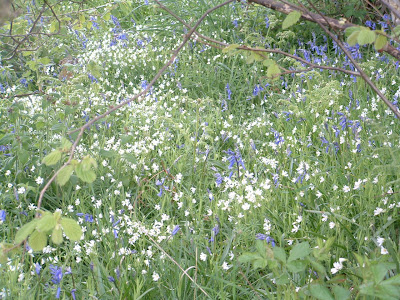
As I walked, the verges were full of bluebells and stitchwort. I remember vividly as a child playing in a bluebell wood with my brother, delirious with the blueness of the flowers, rolling in them as if they were water. I tried to pick some to take home for my mother but they drooped even before we got home and I threw them disappointedly in a ditch by the side of the road. I must have been about eight or nine. I don't remember any guilt about the wanton destruction of the flowers. Bluebells were as common as dandelions then, special only because they were so seductively blue and fleeting. Now I know that many of the bluebell woods of my childhood have vanished, grubbed up for agriculture, built upon for housing, but there are still many here in North Wales although now I would not dream of taking anything but photographs.


Stitchwort is a beautiful little flower, easily overlooked but simple and satisfying. It is named for its apparent ability to ease a runner's stitch, a pain in the side. I shall find out the Welsh names for all of these flowers from a Welsh speaking friend. They crowd the hedge bottoms in their thousands.

I am not sure what this one is below, with a lovely clear yellow flower held above leaves not unlike those of a hardy geranium. I think it might be called Tomentil, a form of potentilla, but if anyone knows for sure I would love to know.


The last bit of my walk took me along the River Wheeler, a small river, rushing clear and brown, where otters are often seen, although sadly never yet by me. The banks to either side for yards and yards are white with wild garlic just now, also known as ramsoms. Crush the leaves and flowers and the smell of garlic is pungent.

It is a beautiful flower, clearly from the same family as the allium in the garden. And thinking of the garden brings on a wry smile. Here I am striving to make a garden in not the easiest of places, reading Beth Chatto about the importance of understanding what plants will happily grow in your soil and trying to create something which will be happy here, sometimes failing, sometimes losing plants to the cold or the stony soil, the picture in my head always years ahead of what you see on the ground. Yet walk the lanes and nature is carelessly throwing out beauty. There is a lesson there again: grow what loves you.