Friday, 30 April 2010

End of month view : April

April has not been the cruellest month this year.  It has been warm and sunny and the garden has exploded into life.

This is the side garden, with the hellebores still flowering away.  Everything else has emerged in fountains of foliage.  The hardy geraniums, of which I have loads, are all in leaf and the day lilies have spurted up.  The paeonies are huge and covered with buds.  Conventional wisdom says that paeonies hate disturbance but these were moved last year as part of the making of the side garden when the building work had finished and even last year they flowered.  There are all sorts of things coming up here: eremurus, lots of aquilegia, the sedums and catmint and, against the stone wall, lots and lots of dusty pink oriental poppies.  It is quite stunning the difference between this end of month view and last month's

Leaves are appearing on the apple tree.  The Tenby daffodils have finished flowering but the Thalia is still flowering around the fruit trees.

And here is the view up towards the cutting garden.  All of the trees in the little orchard have come into leaf now apart from the mulberries.  I think I shall have to start including a closer picture of the cutting garden.  At the moment it still looks fairly empty, waiting for the cosmos and the zinnias which are still in coldframes to be planted out but there are seventy five sweetpeas planted down at the base of the frames which will eventually produce three walls of flowers.

Here is the bank, the quince tree in leaf now and the primroses still flowering.  There are pinks and valerian in here which will start to flower soon and penstemons and sedums for later in the summer.

And here is the kitchen garden, with salad stuff under the cloches, garlic by the greenhouse and tulips and hellebores mixed in with the herbs and salads.  And again, just as last time, taking pictures of the garden from a distance makes me long to show you the detail of flowers: tulips and late daffodils still flowering and erythronium Pagoda  for the first time looking  as if it belongs.  In fact I might have to cheat and do another post with the close up stuff, just to show you.

Saturday, 24 April 2010

Today in my garden


Tiny tulips fizzing.
Primroses smiling.

 Hellebores still glorious.

Apple trees in leaf.


We waited for it so long, but spring is well and truly here.

Wednesday, 21 April 2010

More gardening books - yes!

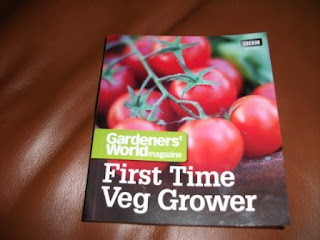
Last week another parcel arrived in my postbox with two books for review: First Time Veg Grower by Martyn Cox and Pests and Diseases by David Hurrion.  They are both BBC books under the banner of Gardeners' World magazine.

There could be nothing better for a garden book addict like me than new gardening books.  I probably wouldn't buy either of these because I am not a first time veg grower and I take a fairly relaxed attitude to pests and diseases, but that doesn't mean I don't set right down to reading them.  They have sat by my bed for a week or so as I have worked my through what to think about before you start growing vegetables and how to cope with ants and codling moth.  I have to admit that ants and codling moths haven't been too riveting but I now know all sorts of things that I didn't know before.


I suppose I thought a book on growing veg would feel very much like a reference book, something like The Vegetable Garden Displayed or the RHS book on growing vegetables, all rotation plans and sections on double digging.  But this book is very much a narrative.  It whizzes along, holding your hand through thinking about how much space and time you have, how to sow seeds and how to get to know your soil.  It helps you choose your tools and consider whether you are going to go for pots, raised beds or go all the way and get yourself an allotment.  The tone is calm and cheerful, encouraging without being gung ho.  You just have the sense that the writer knows what he is talking about, isn't pushing his own agenda or hitting you around the head with his own passions, but is simply confident that you can do whatever you like just as soon as you have worked out what you want to do and how it will fit into your life.  Somehow as you read that easy confidence rubs off on you.  It all seems quite manageable.  Some books blind the new grower with science, some give you so little practical information that you wouldn't know how to start.  This one seems to me to get it spot on.  It's like having an experienced and enthusiastic gardening friend who lets you pick his brains without making you feel stupid for asking.

I particularly like the section on fool proof veg.  The book sets out sixteen vegetables which are straightforward for a beginner to grow.  For each one it tells you where to grow it, when to start, how to sow the seeds and grow them on, tells you what can go wrong and how to prevent it if you can, and finally suggests some varieties.  Simple, easy to find your way around, and full of the kind of information which makes the difference between success and failure, such as letting your onion crop dry out in a light place to prevent them from sprouting.  I didn't know that the first year I grew onions and stored them in my cool dark pantry where they went soft and sprouted in no time.

So I like this book a lot.  It is small enough to carry around with you but thorough enough to cover composting and mulching and how to grow potatoes in a bag.  I will certainly pass it on to one of my newly gardening children.  In fact I think it is so good, I might have to buy another copy.


I am not sure whether my attitude to pests and diseases can fairly be called relaxed or whether I am just lazy.  I try to grow organically so there are various remedies which I wouldn't use and I tend to take the view that if some crops are munched a bit I can generally spare some.  That doesn't mean I am immune to attacks of fury when a line of lettuce disappears overnight though.

This may make me not the best person to look at a book dedicated to pests and diseases.  Maybe you need a real enthusiast! This is a useful little book though, small enough to have in your pocket but comprehensive enough to cover all the most common problems you might come across.  It is not evangelical about either organic or chemical methods, providing details of both approaches,  and does put quite a lot of stress on growing plants in the best way so as to make them less prone to attack, particularly from disease.  As an  organic gardener I would like a book which takes an even more holistic approach perhaps than this one does. But still this is a detailed, useful little book, worth having to refer to when you find your plants looking holey or sad.

Saturday, 17 April 2010

And what if no planes flew again?

Volcanic ash, empty airports, travel chaos, empty skies of streakless blue.  I know it is a problem: our daughter in law and grandson are trying to get back from Florida and our other daughter in law's parents are stuck in Mumbai.  But a little voice inside my head plays with the idea of a world with no flight, with travel slow and the world made huge again.  Would we all go back to holidaying in Scarborough as I did as a child, with no more overcooked Brits shouting and peeling their way around the Mediterranean?

We'd have to give up Kenyan beans and Spanish tomatoes and at last treat seriously the idea that we should grow the food for our country in our country.  What would that do to farming and food prices?  I know we would devastate the livelihoods of the Kenyan producers.  I'm not saying it would be some kind of Utopia, but how very different it would be.

All those middle class kids trogging round Thailand in their gap year would be reduced to interrailing around Europe, not a bad thing perhaps.  All those business trips to the US and the Far East which couldn't happen any more unless we reinstated the big cruise ships sailing the Atlantic.  There would be video conferencing and virtual meetings.  We would all still connect with one another across by world by virtue of the internet, but physically moving people and products around the globe would become slow and costly and a huge contributor to climate change would go at a stroke.

Would we look after the world better if we were more tied to our own place again?  Perhaps not.  The absence of flying didn't prevent the Victorians from throwing up their dark satanic mills and city slums did it?

But still, what would it do to our world if the skies remained blue and silent and empty?

Dream or nightmare, what do you think?

Sunday, 11 April 2010

Spring walk

Today was just one of those perfect days.  I had a list of jobs a mile long but looking after the dog meant that I had first to go for a walk.  The land is greening from day to day practically as I watch.  Although the oaks are still bare there is green on the willows and a quiver of buds on the hawthorn.


Dog and I set off down to the river.  She knows she needs a stick but maybe misjudged it with this one.


With every day there are more wood anenomes by the track down to the river.  How do they grow clinging to the edge of the track, in the scant earth between tree roots?


The dog bounds ahead, stopping every now and then to look back and wait for me, as if tethered by an invisible lead.  The trees above my head are full of birdsong, the long liquid call of a blackbird seems to follow me down the track, moving from tree to tree as I go.  Half way down a buzzard glides above the open field to my right, low enough for me to see the pattern on the undersides of its wings.


In the bottom of the valley the river is fast and clear.  It is not a big river, the Wheeler, but  here and there are pools deep enough to make the dog swim, which she loves.  She emerges black and shining like a seal.
We head upwards from the river along the lane which runs at the bottom of our valley.  The fields are full of lambs and sheep.  Higher up we find the body of a fox by the path.  It can't be long dead, curled as if sleeping.


They are beautiful animals but these days my sympathies are firmly with the chickens.  Our own are scratching about under the quince tree when we get home.  The dog is learning to ignore the chickens, particularly when the chickens ignore the dog.

Two hours have gone away in the sunshine, working on dog time, cockerel time, blackbird time - time without measure.  I sit on the bench with a cup of tea and the dog flopped on the grass beside me and feel happy right down to the soles of my feet.

Thursday, 8 April 2010

This summer's project

We move quite slowly here in terms of what goes on in the garden and then I look back and realise that we have done things and maybe it is beginning to show.   The new native hedges which went in during the autumn of 2008 are looking just a bit more settled this spring as they begin to come into leaf.  There are two lines of mixed edible planting: hawthorn for haws, blackthorn for sloes, dog roses for rose hips and hazel for nuts with one of two cherry plums for good measure.  The dog rose leafs first, its new foliage a bright green spurt against the spiny twigs.

And the new fruit trees are a bit bigger this year too, even if the mulberries are still not yet as as high as my head and won't be for years either by the look of them.  The daffodils round their feet are less spotty than they have been.  They are starting to bulk up and to spread and are just beginning to look like the faintest echo of what is in my head.  It was the daffodils which set me off on this year's project: planting wild flowers around the trees in the orchard.  I love wild flowers and they look very right up here.  I had wondered about making a wild flower meadow in a part of the field but thought that the vivid mixes full of poppies and cornflowers which look so fabulous (there is a wonderful one at the RHS garden at Harlow Carr) would not fit up here.  They are for cornfields.  I needed something gentler, more like the meadows I walked through last year when we walked the Offa's Dyke path but not as full and rich as the meadows of the Wye up here where it is higher and wilder.  Ian suggested wildflowers in the orchard and I spent a bit of time thinking about what I had seen growing wild up here, reading, checking, pottering about on the internet and making lists. I decided to grow the plants in trays and pots so that I could put them in when they are a reasonable size.  I hope this might give them a better chance of competing with the grass than would be the case if I tried to grow everything from seed in situ.

So now I have various things at various stages of growth:

Firstly are oxeye daisies.  I have a dozen of these which I grew from a tiny handful of seed I gathered in the autumn.  I wish I had taken more and taken it more seriously as these are now sturdy plants which have been the first to go out today by the new quince tree.  I have ordered another fifty as plug plants from Wildflowers UK in the hopes of having something really happening this year.  I know they grow on motorway verges and you might think I am quite mad to buy them as plants but I love their simple purity and these are my only indulgence.  Will they take over?  They might but I might not care.

All the images here are  from Emorsgate Seeds who do lots of different wildflowers and have a very helpful website.
Everthing else is being grown from seed.  

I have lots of Anthriscus Sylvestris Ravenswing, a beautiful purple form of cow parsley, a gift from Karen at An Artist's Garden.  
 
This is the common white variety also known as Queen Anne's Lace.  Ravenswing is a purple form, less dominant as a plant I think, with beautiful, dark, finely cut foliage which should stand high above the grass and a flower with a faintly purple haze to it.

I have also sown some honesty, as much for its beautiful seedheads as for the flowers which are pleasant enough but a bit blowsy.  I think a scattering by the plum and the damson trees will be enough.

I am growing field scabious too which grows wild near here in the lane verges.  The seedlings are still tiny.  I can't imagine that they won't be muscled out by grass and oxeye daisies and cow parsley, but I shall let them get as big as they can before they go out and lift some turf around them to give them a chance.  I love the delicate pincushion flowers.
And lastly, although eventually first to flower, are cowslips.  These grow wild up here too, in fact there is a little colony on the edge of our drive.  I want these growing in the open between the mulberry trees, taking over as the daffodils fade.  The seeds need a period of chilling which they have surely had this winter.  I keep inspecting the pots in the coldframe hopefully but no sign yet.
So that is it.  Will it work?  Oh I do hope so.  I can see the mown path between the apple trees in my mind's eye as I go to sleep and hear the insects buzzing in the summer sun.  Mind you, like most things here, it might take a while.

Wednesday, 7 April 2010

Easter weekend

A full few days and now everyone has gone.  I always like this.  I love it when the house if full and busy and everyone is round the table and I love it all over again when everyone goes and the house is quiet and we have the place back to ourselves.

This weekend we had younger daughter and her friends with their three month old baby staying for a few days.  They are great visitors to have.  The girls muck in with cooking or take the making of a meal over entirely and Ady is happy (or at least appears happy!) to help Ian with whatever outdoor project is taking shape.  This weekend's project was making a concrete base to take two 1000 litre water tanks which are going to take the water from the workshop roof and serve the cutting garden and the new fruit and veg beds in the field.

There was still time for much walking of the dog.  There is a great walk down to the river where she can jump and swim for sticks.  Wood anenomes have come into bloom over the week or so she has been here, their delicate flowers and filigree foliage trembling in perfection under the still bare trees.
This isn't one of mine but is by engrailed.co.uk and just catches that delicacy perfectly.

The baby came too in her sling, snug against her father's chest.


On Sunday older son came over after lunch and we had a huge Easter roast dinner with lamb with rosemary and garlic, roast potatoes, roast butternut squash with the last of our tiny red onions, broccoli, carrots, gravy and home made apple and mint jelly.  Afterwards we had apple crumble, our Howgate Wonder apples still lasting after all these months in their informal storage system of hanging up in the rafters in the workshop in plastic bags.  It was the kind of meal where everyone leaves the table with a satisfied sigh.

I made hot cross buns for the first time for ages and they were just delicious, soft and sweet enough yet without the sometimes spongy texture of mass produced ones.

Family visitors had hardly gone when we had a visit from Phil and Alex  (and Phil's dog) who are walking the Offa's Dyke Path to raise funds for the Multiple Schlerosis Society.  You can follow their progress here as they walk the length of Wales.  They put their tent up in the corner of our field and had a huge breakfast here before setting off for another long day's walking.  I had such a great time when I walked the path last year that it was really good to think about it all again as they shared their planning and their progress.  They are really doing it the hard way, carrying a tent and camping gear although with a support vehicle replenishing their supplies.  We carried all our stuff when we did it but sleeping in B&Bs made a bit impact on how much we needed on our backs!  We'll be following them for the next nearly two weeks step by step.  Good luck!

So now everyone has gone and the house is quiet.  In a little while we will take the dog out and then get our seed potatoes in this afternoon.

And this morning I saw the first of the swallows swooping above the stone pigsties where they will nest!  Yes, winter is gone and spring is truly here.

Saturday, 3 April 2010

Garden - End of month view

Slightly belatedly I thought I would like to join the end of month view started by patientgardener   I love seeing other people's end of month views and my own garden changes so much and I forget so much that I thought it would be a good discipline to make a record.

So here is the side garden.  There was a very narrow strip of flower bed along the wall when we came, about two foot wide, and not much else.  The whole of the side garden became a building site when we had the utility rebuilt at the end of 2008.  There wasn't much choice in doing this as the yew tree at the corner of the building was pushing it over.  So last summer was the first attempt at reinstating a garden.  I dug a huge new bed, widened the other one and reseeded the grass.  The soil here is probably the stoniest in the garden so it has been a project to work out what will grow here which will also look as if it belongs.
 I have tried to start some evergreen framework.  In the front of the picture is an eleagnus which I hope will eventually provide a bit of a windbreak as the wind can whistle through here if we get a strong westerly.  There are also three sarcococca humilis, a hebe and several euphorbias in the side bed.  In the bed against the wall is a pittosporum and a phlomis.  The colour at the moment is coming from hellebore orientalis hybrids, five of them in the foreground here and another three in the other bed.  The pale one here was given to me by Karen from An Artist's Garden.  They are flowering beautifully.  I mulched the hellebores with leaf mould earlier this year and they have really responded.  I am tempted to include some close ups but that is not really the point of this post.
 This is what is happening out in what will eventually be a little orchard.  The Tenby daffodils, narcissus obvallaris, are coming out around the fruit trees.  This one is a Howgate Wonder apple which was already here.  There are also a lot of Thalia but they is not yet flowering.


Here is the view up past the new fruit trees towards the cutting garden, empty and sad though it is.  That is probably the place in the garden which changes most dramatically as it fills up with annual flowers.

This is the sunny bank in front of the cottage.  The tree is a little quince.  The daffodils here are just beginning to come out.  There are primroses at the end of the bank and another eleagnus.  This is the driest, sunniest part of the garden and the bank has penstemons and sedums in it, not looking like much at all just now.

The kitchen garden is intended to be mainly for herbs and salads, peas and beans, and plants which attract bees and butterflies.  This is the hardworking end of the garden.  The raised beds are netted at the moment because the hens scratch and the onion sets are in.
It is funny how bare the garden looks when you take distance photographs, whereas close to there are hellebores and primroses and more and more daffodils.  It is the amount  of bare soil I suppose!