Thursday, 23 June 2011

A visit to Bluebell Cottage Gardens

This morning was just meant to be a quick whizz.  Karen and I had arranged to visit Lodge Lane Nursery run by Sue Beesley and just forty five minutes from here.  We had met Sue briefly at the Malvern Show and have communicated on Twitter and read each other's blogs.  I realised that I had visited the nursery under its previous ownership.   I liked Sue's blog.  We liked her plant list.  We thought we would just go and have a look.  This is easy for me from here but a bit more of a challenge for Karen who needs to travel for a couple of hours to get even to my house. But suddenly it all came together.  We could go, today, not for long.  Karen could stay overnight with her mother so we could get on the way early.  I could have a morning off from elder care.  Let's go.

And it was just the best morning ever.  Sue was lovely.  The garden was amazing with that perfect combination of the beds that make you gasp with delight and the bits that Sue is planning to change and the bits that have some stunning plant combinations and some that have got charmingly away and some that just need a kick up the arse (Sue knows all this.  I fear she might know everything) .  The nursery was full of things I wanted and everywhere had the energy and the fizz that come from people doing what they love to do.  I took my camera but I was too busy having fun to use it.   There was of course the moment or series of moments when I was just so overwhelmed by the distance between the whole place and my scabby field with its collection of sticks and nettles that I just wanted to slit my wrists.

But I came home and my garden still felt like my own passion and Karen came up with some stunning ideas for the bits that had been bugging me.

Just the best morning.  Thank you Sue.  Thank you Karen.

Wednesday, 22 June 2011

Home and away

This week we had our first night away since my father in law came to live with us, meticulously planned and much looked forward to.  We had our back up at home in place from a friend and were not going far, less than an hour's drive to Worthenbury Manor, just on the Welsh side of the Border with Cheshire but feeling far more like Cheshire than Wales to me!  Father in law had an early evening meal which suited him down to the ground.  I suspect he would eat at 5pm if it were left to him but we normally keep him hanging on (perfectly cheerfully it must be said) until 6 or even 7 when we have visitors.

The drive was easy and we turned up just as the rain began to pour.  Ian, our host, was at the door with an umbrella and we raced through the downpour into a beautiful small manor house, all panelled walls and polished wood floors.

We had a room with a four poster bed and the house to ourselves.  We had booked an evening meal with them too and the food was as good as a restaurant meal, all cooked by Ian and served by his wife.  We sat at an oak table surrounded by beautiful Jacobean furniture.  It was odd to feel that much of the furnishings were of the age of our house but they would have belonged to a gentleman and would never have got to a farmhouse like ours!  It was a lovely evening, slow and langourous and full of good food, good wine and conversation.  In the morning the breakfast too was superb with local food and home made preserves.


It's amazing how less than twenty four hours can feel like a weekend.  We were home again by late morning but it did feel as if we had been away and I hit the garden in the afternoon re-energised.  If you are ever looking for anywhere to stay on the Cheshire/Wales/Shropshire border do go and see Worthenbury.  It's a really stunning house, the food is marvellous and the hospitality warm.


At home the poppies are going nuts, throwing up their astonishing range of colours and forms: singles, doubles, ones with ragged petals and great bowls of colour in every shade from darkest purple, through lilacs and reds to ballerina pinks.

The Cosmos Purity is almost too perfect a flower to be true.
Here is another poppy thinking it will do something different again.


I did have some verbascum for which these caterpillars are extremely grateful.  It is I think the caterpillar of the mullein moth which eats only verbascum, or mullein.  They can strip a stately verbascum nearly six feet tall in a couple of days leaving a ghostly silver skeleton.


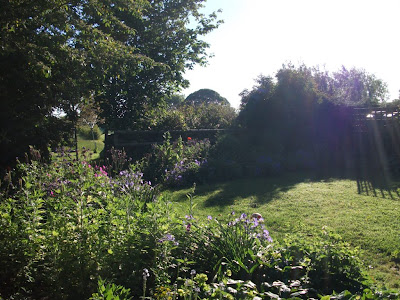
Home was looking pretty good too.

Friday, 17 June 2011

Diary of a novice seed sower

I have been a serious, obsessive gardener for years, but mainly between the months of March and July.  Any earlier and it is too cold and wet for much venturing out for softies like me.  Any later and I used to lose my head of steam and, after a glorious spring and early summer,  subside into drab August, better spent at the seaside.  By the time we all came home again and the kids went back to school there hardly seemed any point.

But now I have got much more interested in late season gardening.  I think this is partly getting older and no longer feeling immortal.  If I only have another ten or twenty or thirty years, writing off half of them as gardening time seems a bit stupid.  And it is partly seeing the gardens of those, like Karen at Artist's Garden, who make their gardens sing at a time when mine used to be all dryness and flop.

So on that front I have made real changes.  But seed sowing, the sign of a real gardener,  was always a real problem for me.  I could take cuttings with rare and glorious success but any sort of sowing direct into the ground was always a total waste of time.  Maybe one tiny seedling would raise its head in an area where I was looking for a swathe of red poppies or a stand of larkspur.  There, you see, I even wasn't trying to sow tricky stuff.  I was just hopeless at it.  And then the tiny seedling would be munched by a passing snail or stood on by me when weeding and it was all just a bit depressing.

But I have come round now.  I have been dipping my toe into the world of seed sowing  for a couple of years now and this year I sowed all sorts of seed  in the greenhouse.  I have mastered heated propagtors and the whole business of taking lids off and putting them back on again and not forgetting that I have seeds out there at all.  All sorts of stuff came up: cosmos purity, quite big plants now all lined up in the cold frame, waiting to move into the wasteland that will be where the oriental poppies have been when they are all cut down in a week or two; blue lupins from some seed given to me by a friend; cosmos sulpureus in orange and yellow; wallflowers for next year (did you get that? forward thinking even!).  There are rudbeckia hirta and nicotiana sylvestris, still small but growing by the day.  There is larkspur and clary, smaller still but growing.

It was all going so well.

And then over the last week, morning after morning, cosmos with its heart taken out, plants felled, gaps like lost teeth in the cutting garden.

I have been growing organically for ten years or so but what I want to know is, what are slugs for?

Thursday, 9 June 2011

Keeping chickens - the dark side

I love keeping hens.  I love the eggs, brown and speckled with vivid orange yolks and a taste which beats even the best shop bought free range eggs.  I love the way they are a presence in the garden, rushing and clucking and shouting to each other and bustling about.  Watching them always makes me smile and the garden would feel empty and dead without them, although it might be quite a lot tidier.


But it's time to lift the veil on the less pleasant side of chicken keeping.  Those of a squeamish disposition should look away now.

One of our older hens is a Welsummer, a dark brown hen who lays dark brown eggs.  She was given to me by a friend because she was being mercilessly bullied in her flock and my friend wondered if a new flock would let her have a new start, a bit like sending a bullied child to a new primary school!

It took her ages to settle in when she came.  She didn't seem to be bullied here, partly I think because she clearly knew her place in the pecking order from the first: right at the very bottom.  But she didn't join the flock at all for days and days, loitering forlornly by the hen house, then gradually following the others several yards behind, like a child hanging around on the edge of a playground group.  Then one day I looked out of the window and there she was, steaming up to the bird feeders with the others as if she had always been  part of the group, right in the middle of the scratching and clucking under the trees, putting herself to bed at night with the others and taking her place on the perch instead of the floor of the hen house.  She had cracked it.

Since then she has taken her place as one of the boldest of the hens, moved smartly up the pecking order and is now the first to invade a newly dug vegetable bed and to scratch around my seedlings before I have managed to get the barriers in place to protect them.  She often gets a clod of soft earth tossed in her direction to make her move out of the way.  She lays four or five eggs a week and I choose to have her eggs if I am breakfasting on boiled eggs and toast soldiers because the colour is so fine, dark brown with even darker brown speckles like rich plain chocolate.

Last week when my son and daughter in law were here we went down to let the hens out for their afternoon of foraging and free ranging.  There was something about the way the Welsummer was standing that was  not quite right.  She came more slowly out of the run and when she headed off up the garden I could see that her rear, instead of being covered in deep downy brown feathers, was streaked with yellowy white and hanging with dark brown faeces.  Chris and Katie had just lost one of their first ever hens to maggot strike (don't ask, it's just as horrid as you might think it is) and had been told by a vet friend how important it was to clean up a hen with this sort of problem.  We agreed that evening when hens are more docile and dopey might be the time to do it and went off to consult books and internet advice.

It seemed that she might perhaps be egg bound.  Graphic pictures showed prolapses and articles described bathing the hen's backside in warm water and greasing the vent with vaseline.  We raised our eyebrows at each other.

That evening there was football on the television which is certainly the only reason that our menfolk were conspicuously absent as Katie and I, all gloved up and with a jar of vaseline in my pocket, set off down to the hen run.  The hen wasn't keen to be taken off her perch but once firmly grasped the frantic clucking stopped and she sat quietly as I clamped her wings equally firmly to her sides .  We took her up to the utility and ran a sink of warm water.  Then I held her and  lowered her in while Katie gently tried to clean her bottom.  She did indeed have a prolapse.  Katie used her slim fingers and her medical training as a junior doctor to gently push things back in place.  I am not sure how you can tell that a hen is not keen but co-operating, it certainly isn't the expression on her face, but that is how it seemed.  The hen was quiet.  She didn't struggle and we bathed and greased her and kept her in the warm water for a while.  Then it was out onto an old towel, an attempt at drying her wet feathers (have you ever tried to dry a hen?  I think a hairdrier might be the answer) and then we installed her in an old cat basket for the night.  The books said she should be isolated from the other hens who might peck her in her weakened state.

We did try to isolate her but our efforts were scuppered by a quietly inquiring visit by the dog which sent the hen flying off into the mock orange bush, refusing utterly to come out.  When the other hens were let out in the afternoon the Welsummer rejoined the flock and we left her in peace with them back in the hen house for the following night.  The next day she spent a long time in the nest box, finally laying a large, slightly misshapen egg which was delicious poached on toast for my breakfast.  For a day or two she continued to look a bit bedraggled in the rear but now, a week on, normal service is restored, the feathers are clean and downy once again and she is laying to her usual pattern.

One of the things I read in my poultry books indicated that an egg bound hen in a commercial flock would either die or be culled.  That seems a pity.  But I am glad I had company on the night of the latex gloves and vaseline.  Thank you Katie.