gardens and growing things, cooking and eating things, family and friends, books and wine
Tuesday, 27 September 2011
Roots and wings in Wales and Provence
I think this is a good thing, this putting down roots, although I cannot be sure, but it is easy living up here with land and livestock to care for and family commitments to keep you at home, to begin to feel not so much rooted as tethered. And when you do it is good to take wing.
So we did, Ryanair wing. A friend came in and our son and daughter in law came up to stay for the weekend to help look after my father in law, and off we went to Provence to visit friends. And it was glorious. We admired the beautiful house and garden our friends are creating, balancing with much thought and care and skill, the aesthetics of a garden which surrounds a dramatic piece of modern architecture with their overriding wish to create a garden which will nourish all forms of wildlife. It was great to lift my head from my own patch of land and really look at someone else's garden, although I felt I needed months of reading and research to understand the soil and the climate which are so different from my own. We had so much good food and good wine and good conversation that we may be able to live on egg and chips and silence for a week or two now we are back.
We climbed towers and wandered narrow streets.
We found a beautiful medieval garden full of many of the plants I grow at home
and some that I do not. I never knew that capers had such beautiful flowers.
We ate an extraordinary meal at a restaurant in Arles, L'Atelier. This was food as an experience, a meal as a performance, a tour de force.
We walked in the Camargue, limpid light in the sky and the sea.
We stood by the pool in the darkness, the air still warm and pine scented on the skin. We walked and talked in a wood full of pine and cedar and butterflies. It felt as though we were away for a week, not a weekend, and now we are home it seems unbelievable that only yesterday we were eating a fabulous lunch in a restaurant on the square in the Provencal sun.
I woke this morning in my own bed to a perfect early autumn day, the sky streaked blue and gold. And home was beautiful too. The grass was green and lush, the garden a sea of tiny michelmas daisies and deep gold and mahogany rudbeckia. The apple trees were bowed down with red flushed fruit. Sedum and salvia hummed with bees and butterflies. I saw it differently, with renewed love, wandering outside for half a breathless hour before I went out to work this morning. Just for a moment I thought I understood something about the impossible tension between roots and wings and then it went, a butterfly thought. I shall stick with the simple: it is good to go away. It is good to come home again.
Wednesday, 21 September 2011
Autumn blows in
The second hatching of chicks this year produced these three: two Scots Dumpies, with the grey and white feathering now settling as they lose their fluffy chickness and emerge from the spiky teenage stage, and one brown Barnevelder, still a bit scraggy about the neck. They are going outside in a week or so to a new chicken house which Ian has been weather proofing.
I like the design of this one very much, with the area under the house to extend the run for the chickens when they are confined, a ramp down from the house and such refinements as a double nest box, just seen at the side, and a peephole at the back. Ian tells me that this is a ventilation hole, with a cover which you can slide over it. I prefer to think of it as a peephole which you can open to check whether there is anyone in residence on the perch.
Upstairs in younger daughter's room, well away from the predatory cat, the all-singing, all-dancing, humidifying, self-turning, extraordinary incubator, borrowed from some very kind friends when we realised that we were not going to be able to turn the eggs three times a day for the full twenty one days of the hatching period, whizzes and hums and sings to itself. In the next couple of days some more eggs should begin to hatch. We have fingers crossed for these as it perhaps a bit late in the year for good fertility, but we shall see, very soon now.
At the bottom of the field the wind whips the silver birch and the contorted willow although next to the house the side garden is utterly still.
Rosehips gleam in the new hedges. They were planted four years ago now with mixed native hedge plants which produce edible fruit: hips, haws and sloes, as well as hazelnuts if you can get to them before the squirrels do.
We lifted the rest of the main crop potatoes. This is we as in Ian you understand. He wields the fork. I sort the potatoes into those which will go into bags to be stored and those which are slightly damaged, by slugs or by the fork, and which need to come into the house to be eaten.
This year for the first time ever we have managed to grow some sweetcorn big enough to be eaten. High on a Welsh hill is not the natural territory for sweetcorn and some of the kernels have failed to plump up and have been given to the delighted chickens. But there are four cobs with rich, yellow kernels. It astonishes me sometimes, the imperative of growth, determination of plants to grow. It is the force that through the green fuse drives the wire. Do you know it? Dylan Thomas's extraordinary poem, simultaneously for me exhilerating and sombre.
Down in the valley the grass is cut and the field is brown. The trees are green still. Stay your blowing hand, winter. I am not done with autumn yet. There are apples to be picked. And excitingly, even before that, there is a last lingering look at summer to be had next weekend. Our son and daughter in law are coming for the weekend to look after the house, the animals and to keep father in law company while we go to see our dear friends in Provence. This will be our first weekend away together in nearly a year. I love it up here but sometimes you love a place most when you come back to it. It will all still be here when we come home with the sun on our faces.
Saturday, 17 September 2011
Beetroot and pears
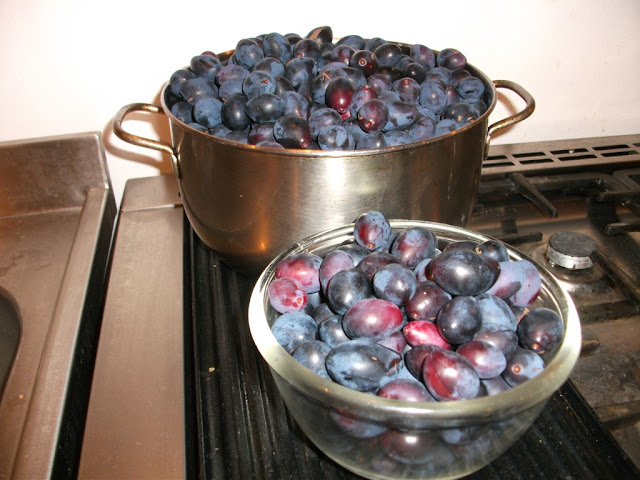
How can this be? It was the same with the damsons and the plums so I suspect our gloriously warm and dry spring (do you remember?) was just what the fruit crop wanted. The same holds true for vegetable crops of course. One day you are cutting your first beans and eating them simply dressed with butter and drooling at their deliciousness. The next you are wilting slightly in the face of trugs full of the things marching into the kitchen, each bean as long and thick as your arm and about as appetising.
Oddly, the pears that came inside in buckets have not ripened on the kitchen table but remain stubbornly hard and unyielding. The answer to what to do with a bucket of rock hard pears came, as preserving answers so often do, from Pam Corbin's River Cottage Preserves book. I have all sorts of preserving books: a Women's Institute one which I have had for ever and is good on the basics; one by Marguerite Patten who, at ninety three, has been teaching people how to cook seasonally and frugally since the second world war and who knows everything, and a new, gloriously illustrated, one by Thane Prince with an unusual modern touch. I love them all but if I had to choose only one to keep it would be the River Cottage book. Pam Corbin knows so much and shares all the little tips and touches you only know as a result of years spent over the preserving pan. But the recipes are lively and interesting too and the whole book is beautifully written. It is not possible to flip through the book without coming up with half a dozen things you fancy trying.
I went for the Mulled Spiced Pears.
You peel the pears and keep them in very slightly salted water to stop them browning. Each pear half is studded with two or three cloves. You make a syrup with water, cider and sugar and pack the pears into jars, each jar with a stick of cinnamon in it. Top the jars up with the syrup, lower but don't secure the lids, and let the jars stand in an oven at about 150 degrees for around an hour.
When they come out, secure the lids and leave until they are absolutely cold. You will need to check that the seals are tight the next day before putting them away on a shelf in the larder. They will keep for about a year. We might have some at Christmas with dark chocolate sauce and thick cream.
While I have been doing this in the front kitchen where the cooking now takes place, Ian has been moving on with the back kitchen, soon to become the scullery/utility.
Look, look! The new slate floor! Soon it will meet up with the old slate floor in the front kitchen. The front kitchen is in the old part of the house and each of the well worn slates is around 5 feet long and 3 feet wide. Heaven knows how thick they are and heaven knows how they were lifted into the house but they have been down for hundreds of years and will no doubt stay there for another few hundred. The new slate in the 1980s extension matches the old slate perfectly for colour if not for size!
It's all happening up on the hill.
Whoops. I forgot to tell you about how to make beetroot (hated taste and texture of my childhood) irresistibly delicious.
Wednesday, 14 September 2011
Walking
I have been reading the diaries of Dorothy Wordsworth. I read them years ago when I was doing my degree and studying William Wordsworth's poetry. I would like to be able to tell you that her diaries illuminated his poetry for me but I don't think they did. I was too young, too green, too self-absorbed. I got stuck on the way her creativity was subsumed into his, both of them taking utterly for granted the supremacy of his talent. I was a feminist, still am, but then I was a certain-sure feminist without much capacity for complexity or subtlety. I am not sure how much I can claim to understand about the human condition now, but having got to my fifties I am far less certain about any of those ideologies which used to seem so clear.
Now I am entranced by her observations, intrigued by the minutiae of their lives and grasp more fully than I did at twenty the depth of her love for him. But what strikes me most reading it now, and which shows that I am not and never was a scholar, is how much walking they do! They walk to see friends. They walk to collect the post, to shop, to go to church. They walk to gain viewpoints or to see the sun set. They walk morning, afternoon and evening, winter and summer. They walk together or with others and when William goes off to Scarborough to visit the girl who will become his wife, Dorothy walks just as far and just as frequently alone. Going out to walk is such a part of the fabric of their lives that on the very rare occasions when they don't walk, Dorothy notes "Did not walk today".
Earlier this year I also read Francis Kilvert's diaries. He was a parson with a parish called Clyro on the border between Wales and Herefordshire. The diaries, written in the 1870's, seventy years or so after Dorothy's, are fascinating, if unsettling, reading in the twenty first century. Kilvert too has a keen eye for natural beauty and a warm, generous nature which is endearing. He also has a passionate ardour for the beauty of young girls. My own view is that this was not sexual, or never sexually expressed. It is hard for a society obsessed with the threat of paedophilia (a dreadful threat, and one which for generations was treated as if invisible) to contemplate the idea that a more repressed society than ours might sometimes have acted to constrain sexual misdemeanour. If an act is unspeakable, that can for some make it unthinkable and I think that is perhaps how it was for Kilvert.
Kilvert was a good man, a good vicar and one who worked hard for his parishioners. He was also an inveterate walker. He thought nothing of walking twelve miles to have dinner. Now I live just under twelve miles from my nearest town. Say I walk at something around three miles an hour (middling, not fast, not impossibly slow) it would take me somewhere between three and a half and four hours to walk there. If Kilvert was lucky he would be offered a bed for the night but even a one way journey seems an astonishing distance to go for an evening's sociability.
Dorothy was writing in the early 1800s and Francis Kilvert seventy years later. If you had gone back to the 1700s, the 1600s and earlier, dependence on walking as the ordinary way of getting from one place to another would have been the norm as it still is in parts of the world today. Fast forward another seventy years to the 1940s and trains had changed the way people travelled and cars had come within the reach of many. But even then people walked. My mother walked to school. My father walked for forty minutes each way to work.
Walking as a means of getting from one place to another has practically died out in the early twenty first century. We leap into cars at the least opportunity. We drive our children to school. We drive to work and play and the supermarket and the retail park The three or four hours a day which Dorothy and Francis and all of our forebears routinely spent on their feet walking about their daily business have disappeared from memory. It's no wonder we struggle with obesity when you combine how little we walk with how easy it is to consume the high fat and high sugar food which used to be reserved for high days and holidays.
How much have you walked today? I don't mean walking out to the car or pottering around the house. I mean walking consistently, say for longer than ten minutes? I confess the answer for me today so far is not at all - the furthest I have gone is to let the hens out. But today I will walk. I love walking. It slows me down, clears my head, makes me see the natural world around me in a different way to working in the garden. And I am feeling that man was meant to walk.
So, measured either in distance or in time, how far have you walked today?
Monday, 5 September 2011
Damsons
In August 2009 Ian and a friend picked bags full of wild damsons from the hedgerow. Last year we went down to the footpath hoping to gather more but the tree was bare of fruit. Were we too late. Had someone or something else been there before us? We didn't know but it was wonderful to see our own crop ripening on the tree.
The fruit produces a jam which is dense and dark, its sweetness undercut by a delicious sophisticated tartness. The downside of damsons is their stones. Unlike plums, they are not easy to stone when they are uncooked so today Ian and I have both spent what feels like hours fishing stones out of the jam as it cooks.
This drove Ian to internet search for what other people do with damson stones and we might even have a try with a cherry stoner with the remaining smaller number, taking them out of the uncooked fruit. It is quite impossible to do with a knife.
So we stand over the pan and the sieve and the pile of stones mounts and eventually the dark liquid seems without stones and it is time to bring the temperature up and boil for setting point.
The jars gleam and shine. But what can you see in the second jar from the left? How can it be a stone? Tell me it is just a trick of the light.
Easier by far is damson gin. You prick the damsons to release the juice. This is not quite as vital as it is for sloe gin as damsons are softer and more yielding but it does speed the process. Then you add half the weight of sugar. For every 450g of damsons you add 600ml of gin. Ours is Tesco gin and, extraordinarily, Tesco value! How wonderful is that? If you are not a reader in the UK, Tesco is a big supermarket chain and Tesco Value products are the cheapest way of buying basics: flour, cereal, coffee, bread and, apparently, gin! I love it.
Shake it every day for eight days and then every week for eight weeks. Drain the resulting dark, sweet liquor into bottles and keep for Christmas. Fight over what to do with the sugar soaked, gin soaked damsons.
Thursday, 1 September 2011
End of month view accompanied by random facts
This is the usual side garden view taken so early that there was no sun on the back border which is the main place in the garden where I am trying to think about autumn. My garden is definitely a spring and early summer garden, or at least it was. I am gently extending its season I hope.
I thought you could see so little of it that I would allow myself an extra couple of photos from a bit closer. Here the perennial rudbeckia is beginning to get going against the drifts of fennel.
Here is the whole of the border with the annual rudbeckia and cosmos sulphereus "Sunset" just beginning to get going. They may not look much to you but I am very proud of them. I grew them from seed as part of my determination this year to become more proficient at it.
There is fine line when you garden in a supposedly naturalistic and closely planted style, as I do, between generous abundance and chaos. This border is just on the right side of the line. The other border, which I am sneakily not showing you a picture of, has crossed the line into simple mess.
Random fact number one: all of my children and stepchildren are taller than I am. This does not in anyway diminish my authority, perhaps because I don't have any now. They are all way too old for telling.
In the orchard most of the crop has been taken off the plum tree but it is still weighted down with the remaining fruit. The grass in the orchard will be cut soon. Last year Ian scythed it. I am not sure if it will be scythed or strimmed this year.
Random fact number two: I find the sight of a scything man very attractive, not just any scything man I suppose.
The cutting garden is the best it has been. It still needs the box to become hedges and I must remember to plant even more closely than I did this year but the basic idea is better than the stripes I had before. Next time I must see if I can find a shorter version of the black cornflower I grew this year. I love it as a contrast, particularly against vibrant yellows and oranges from the other end of the cutting bed, but it did get comprehensively blown over.
Random fact number three: This house, built in about 1610, is the oldest one I have ever lived in. If you live in an old house it is a good thing not to mind spiders who also want to share your space. Luckily spiders don't bother me; slugs now, I hate slugs, and not simply because they eat my plants.
The new hedges are as beautiful as anything else in the garden. This is rosa rugosa in the mixed native hedge.
The moles have been busy. Another beauty of gardening in a natural, nay scruffy way, is that I don't care.
Random fact number four: Despite three years of trying, and the fact that I can understand quite a lot now, I still can't really speak Welsh. Dw'i ddim yn medru siarad Cymraeg.
The kitchen garden will look crisper soon. The hedges are about to be cut: hawthorn, holly along the left hand boundary and yew at the far end. The orange netting you can see here is an attempt to confine the chickens to the far end of the garden. This works fine with the Light Sussex and the Welsummer but the Frisian cockerel and his two hens take not the slightest bit of notice. We are contemplating, with some slight trepidation on my part, wing clipping.
Random fact number five: I have long toes.